That little check engine light just came on, and now you’re staring at a code that looks like alphabet soup. Whether you’re buying a used car or managing a fleet of vehicles, understanding DTC diagnostic trouble codes can save you a lot of money and stress. This guide breaks it all down in plain English.
What Are DTC Codes?
A diagnostic trouble code, or DTC, is an alphanumeric code your vehicle generates when its onboard computer detects a problem. Think of it as your car’s way of raising its hand and saying something’s wrong. The code gets stored in the vehicle’s OBD system, which stands for On-Board Diagnostics.
Every car sold in the US after 1996 uses the OBD-II standard, which standardized how these codes work across manufacturers. Before you could run a scanner and get the same format of code whether you were looking at a Ford or a Honda. Heavier commercial vehicles often use the J1939 protocol instead, which is a separate standard designed for trucks and fleet equipment.
When a malfunction is detected, the vehicle’s ECU (engine control unit) logs a DTC and, in many cases, triggers the check engine light on your dashboard. That light is your first clue that something needs attention.
How to Read a DTC
Every DTC code follows the same structure. Once you understand it, you can decode any code you come across. The format is one letter followed by four numbers, like P0300.
Here’s what each part means:
- First character (letter): The system affected. P = Powertrain, B = Body, C = Chassis, U = Network/Communication.
- Second character (number): 0 means it’s a standardized OBD code. 1 means it’s manufacturer-specific.
- Third character: The subsystem, like fuel, ignition, or transmission.
- Last two characters: The specific fault number within that subsystem.
So if you pull a code like P0420, you’re looking at a powertrain issue, a standardized code, related to the emissions system. Specifically, it’s a catalytic converter efficiency fault. That’s a lot of information packed into five characters.
Types of DTC Codes
Not all DTCs are equal. Some flag a minor sensor glitch that barely affects performance. Others point to something that could leave you stranded or cause serious engine damage if you ignore it.
OBD-II codes are organized into a few main categories. Powertrain codes (P codes) are the ones most people encounter. They cover everything from your engine and fuel system to the transmission and exhaust. Body codes (B codes) relate to things like airbags, power windows, and seats. Chassis codes (C codes) cover braking and steering systems. Network codes (U codes) deal with communication between your vehicle’s computers.
Beyond categories, DTCs also carry severity levels. Some are informational, some are warnings, and some are critical faults that demand immediate attention. A critical malfunction code tied to the braking system or transmission is very different from a minor evaporative emissions fault.
Common Diagnostic Trouble Codes
A handful of DTC codes show up again and again, especially on used cars. Knowing these will help you spot red flags fast.
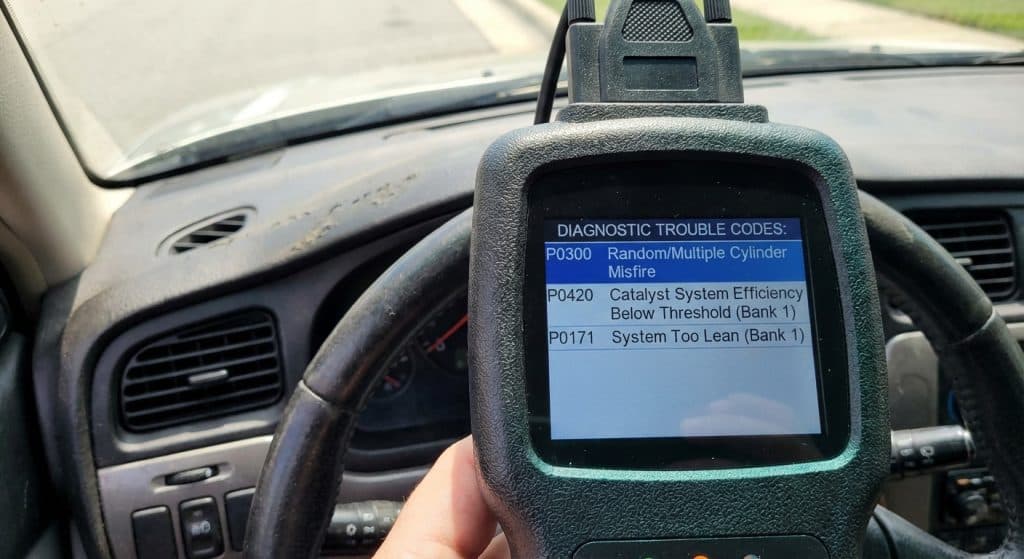
P0300 means random or multiple cylinder misfires. This one can be caused by worn spark plugs, bad ignition coils, or more serious issues like a blown head gasket. If a used car you’re looking at has this in its history, ask questions.
P0420 points to a catalyst system efficiency issue below the threshold on bank 1. It’s often a failing catalytic converter, which can be expensive to replace. Sometimes it’s just an oxygen sensor giving bad readings, which is cheaper. Either way, don’t ignore it.
P0171 and P0174 both indicate the engine is running too lean, meaning too much air and not enough fuel. Common causes include a vacuum leak, a dirty mass airflow sensor, or a weak fuel pump.
P0700 is a transmission control system malfunction. This one’s serious. It means the TCM (transmission control module) has detected a fault and logged its own set of codes. A used car with this code in its history deserves a very close look before you buy.
U0100 is a lost communication fault between the ECU and another module. This network-level DTC can indicate wiring problems or module failures, and it’s the kind of thing that can be hard to diagnose without professional help.
Interpreting DTCs as a Used Car Buyer
Here’s the thing most buyers don’t realize. A seller can clear DTCs with a scanner right before you show up. The codes disappear from the display, but the underlying malfunction doesn’t. That’s why a visual inspection and a test drive aren’t enough on their own.
You should always run a free VIN lookup tool before buying any used car. A good VIN check can surface recall history, odometer data, and past ownership records that give you context around any diagnostics you find during an inspection.
Bring your own OBD-II scanner or ask a mechanic to plug one in during inspection. If the readiness monitors aren’t complete, that’s a sign the codes were recently cleared. The vehicle hasn’t had time to run through all its self-tests yet, which is a red flag.
You want to understand DTC severity before you walk away from a deal or negotiate a lower price. A stored P0441 (evaporative emission system incorrect purge flow) is often cheap to fix. A P0016 (crankshaft to camshaft correlation) can mean serious internal engine timing issues. Same letter, very different outcomes.
How to Read DTC Fault Codes Yourself
You don’t need to be a mechanic to pull DTCs. A basic OBD-II scanner costs between $20 and $100 at any auto parts store. Plug it into the OBD port, which is usually located under the dashboard on the driver’s side. Turn the ignition to the “on” position without starting the engine, and the scanner will communicate with the vehicle’s computer.
The device will display any stored or pending DTCs. Stored codes are confirmed faults. Pending codes are issues the system has detected once but hasn’t confirmed yet with a second occurrence. Both are worth investigating.
Once you have your codes, cross-reference them online using a reputable OBD database. Sites like Geotab and Samsara maintain detailed code libraries. You can also look up manufacturer-specific codes, which start with a 1 in the second position, in the owner’s manual or through the dealership.
For commercial vehicles using the J1939 protocol, the process is similar but requires a scanner that supports the J1939 standard. Many modern heavy-duty diagnostic tools handle both OBD-II and J1939, which is useful if you’re buying a used pickup or light commercial truck.
Modern Advancements in DTC Monitoring
Vehicle diagnostics have come a long way from plugging in a handheld scanner at the shop. Today, telematics systems can monitor DTCs in real time, the moment a malfunction is detected by the vehicle’s OBD system.
Telematics devices plug into the OBD port and transmit data wirelessly to a cloud platform. When a DTC triggers, fleet managers get an instant alert with the code, the vehicle ID, and often a severity rating. No waiting for a driver to mention the check engine light has been on for a week.
Platforms like Motive, Geotab, and Samsara have built sophisticated diagnostics dashboards around this data. They can track trends across a fleet, flag recurring DTCs on specific vehicles, and even predict when a malfunction is likely to escalate from minor to critical based on historical patterns.
The J1939 standard, used in commercial trucks and heavy equipment, carries even richer data than OBD-II. A J1939-compatible telematics device can pull fault codes from multiple control modules simultaneously, giving fleet management teams a much fuller picture of vehicle health.
Benefits of Real-Time DTC Monitoring
For individual car owners, catching a DTC early means you fix a $30 sensor before it turns into a $1,500 repair. For businesses, it’s about keeping vehicles on the road and out of the shop.
Real-time DTC monitoring through telematics lets fleet management teams schedule preventive maintenance instead of reacting to breakdowns. A malfunction that gets flagged Monday morning can be scheduled for repair Thursday, not discovered when the vehicle breaks down on a delivery route Wednesday afternoon.
The financial case is straightforward. According to fleet industry data, unplanned downtime costs significantly more than planned maintenance. When telematics systems surface DTCs early, the severity and cost of repairs typically go down.
Sensor data from telematics systems also helps identify patterns. If the same DTC code keeps appearing across multiple vehicles in your fleet, it might point to a systemic issue, a bad batch of parts, or a driver behavior pattern that’s causing premature wear.
Automating DTC Management with Telematics
Manual tracking of DTCs across even a small fleet is a full-time job. That’s where automation through telematics really earns its keep. Modern platforms can automatically route a fault code alert to the right technician, log the event in the vehicle’s maintenance record, and update the work order system without anyone typing a thing.
Some telematics systems can even differentiate between a DTC that needs same-day attention and one that can wait for the next scheduled service. They factor in code severity, current vehicle utilization, and upcoming maintenance windows to recommend the best time to pull a vehicle for repair.
For fleet management teams running vehicles with J1939 systems, like Class 6, 7, and 8 trucks, the depth of data available through automated telematics is especially valuable. The J1939 protocol surfaces fault codes from the engine, transmission, brakes, and powertrain as separate streams of data that can all be monitored from a single dashboard.
Best Practices for Fleet Managers
If you’re overseeing a fleet, a clear process around DTCs will save you headaches. Start by making sure every vehicle has a compatible telematics device installed so you’re capturing OBD data automatically. Don’t rely on drivers to self-report the check engine light.
Set up severity-based alert thresholds so your team isn’t buried in notifications for every minor fault code. Critical DTCs related to the powertrain, brakes, or transmission should trigger immediate escalation. Lower severity codes can roll into your regular maintenance queue.
Train your drivers to understand that a check engine light isn’t something to cover with a piece of tape. Even a low-severity malfunction can compound over time. Getting drivers to report warning lights immediately is the first step before your telematics platform takes over the rest.
Keep a log of recurring DTCs by vehicle. If one unit keeps throwing the same fault code after every repair, the underlying issue may not be getting fixed properly. That history is valuable when you’re deciding whether to repair or replace a vehicle.
Diagnostic Trouble Codes and Telematics
The connection between DTCs and telematics is only getting tighter. Newer vehicles broadcast OBD data continuously, and telematics platforms are getting smarter about what to do with it. Machine learning models can now predict which DTC is likely to appear next based on sensor readings and historical patterns, even before the malfunction officially triggers a code.
This is the direction vehicle diagnostics is heading, from reactive to predictive. For used car buyers, this matters too. A vehicle with a clean telematics history and no recurring DTCs is a much safer bet than one with a spotty record, even if the check engine light is off when you look at it.
If you’re financing a purchase after reading this, plug your numbers into our car loan calculator to understand what the total cost of ownership looks like. And if you want to compare models before you start shopping, browse used cars by make to see what’s available with full vehicle history data.
Understanding DTCs won’t make every used car purchase easy, but it will make you a much harder person to fool. Pull the codes, run the VIN, get an independent inspection, and don’t let anyone tell you a lit check engine light is “no big deal.” It might be. It might not be. The only way to know is to look it up.
Was this helpful?
Put it to work. Research your next car or browse our top gear picks.