Buying a used car today means sorting through a lot more than trim levels and mileage. Advanced driver assistance systems have changed what it means to feel safe behind the wheel, and knowing what you’re looking at can make a real difference in the car you choose.
This guide breaks down everything you need to know about ADAS car safety features, from the basics to the tech underneath the hood. Whether you’re buying your first car or upgrading to something safer for your family, you’ll leave here knowing exactly what to look for.
What Is ADAS?
Advanced driver assistance systems, or ADAS, are a collection of automotive technologies designed to help drivers avoid accidents and stay in control. These systems use cameras, radar, and sensors mounted around the vehicle to monitor traffic, road markings, pedestrians, and obstacles in real time.
The term covers a wide range of features. Some ADAS features simply alert you to a problem. Others step in and take action on your behalf, like automatically applying the brake or steering you back into your lane. The goal of all of them is the same: to improve safety by catching what human eyes sometimes miss.
Most new cars today come with some version of an ADAS system as standard equipment. In the used car market, you’ll find these features more commonly on vehicles from 2016 onward, though some automotive brands were offering them as early as the late 2000s.
A Brief History: How ADAS Technologies Evolved
The roots of ADAS technologies go back further than most people realize. Anti-lock braking systems, which most drivers take for granted today, were one of the earliest forms of driver assistance. They showed up on production vehicles in the 1970s and became widespread through the 1980s and 1990s.
Electronic stability control followed in the 1990s, and by the mid-2000s, automotive manufacturers were starting to pair sensor technology with cameras to build more sophisticated systems. Lane departure warnings, adaptive cruise control, and early versions of automatic emergency braking started appearing on luxury vehicles first, then trickled down to mainstream models.
Today, ADAS features are so common that many regulators and automotive safety organizations have pushed to make certain features mandatory. The jump from basic alerts to semi-autonomous vehicle functions happened fast, and it’s still accelerating.
The Technological Backbone of ADAS
None of this works without the right hardware. ADAS sensors are the foundation of every system on this list. Different sensor types pick up different kinds of information, and most modern vehicles use several of them working together.
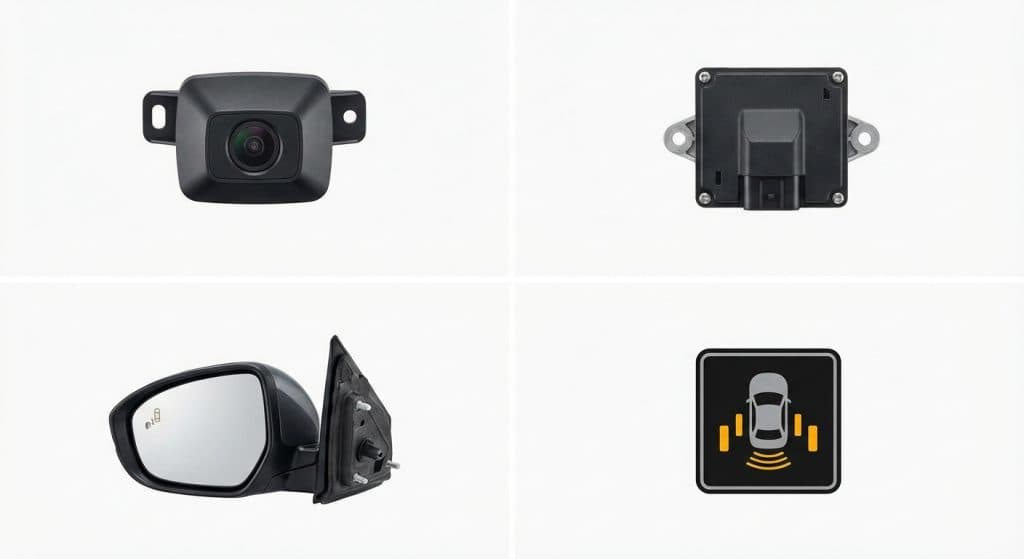
Radar sensors are great at detecting speed and distance, even in bad weather. You’ll find radar sensors at the front and rear of most vehicles with adaptive cruise control or automatic emergency braking. Camera sensors are better at reading lane markings and identifying pedestrians. Ultrasonic sensors handle short-range detection, which is why they’re commonly used in parking assistance systems.
Some vehicles add LIDAR, which uses laser pulses to build a detailed 3D map of the surroundings. You’ll find LIDAR more often in vehicles testing autonomous vehicle technology, though it’s starting to show up in production models too.
The sensor fusion process, where data from all these sources gets combined and processed, is what makes the whole ADAS system feel seamless. When it works well, you barely notice it. When a sensor gets dirty, blocked, or misaligned, things can go wrong fast. That’s something to keep in mind when buying used.
Collision Warning Systems
Forward collision warning is one of the most common ADAS features you’ll find on used cars. It uses a front-facing camera or radar sensor to monitor the gap between your car and the vehicle ahead. If you’re closing in too fast, the system sends an alert, usually a beep, a flashing light on the dashboard, or both.
Some systems also include pedestrian detection or cyclist detection, using the camera sensor to identify more than just other vehicles. Rear cross-traffic alert works on a similar principle, using rear-facing sensors to warn you when something is crossing behind you while you’re reversing.
Blind spot monitoring is another alert-only system that’s become nearly standard on mid-range and higher trims. A sensor on each side of the vehicle detects cars traveling in your blind spot, usually signaling with a light in or near the side mirror. Ignore the alert and change lanes anyway, and some systems will give a stronger warning through the steering wheel or seat.
Collision Intervention: When ADAS Takes Over
Alert systems tell you about a problem. Intervention systems try to prevent the collision from happening at all.
Automatic emergency braking is the big one. When the sensor detects an imminent collision and the driver doesn’t respond quickly enough, the ADAS system applies the brake automatically. The Insurance Institute for Highway Safety has found that automatic emergency braking with pedestrian detection significantly reduces front-to-rear crashes, though the exact figures vary by vehicle and study.
Some vehicles use brake assist as a complementary feature. When it senses a panic brake situation (the driver pressing hard and fast), it maximizes brake pressure to reduce stopping distance.
Lane keeping assist goes a step further than lane departure warning. Instead of just alerting you, it applies gentle steering input to guide you back into your lane if you start to drift. More advanced versions actively keep you centered in the lane at highway speeds, which starts to overlap with semi-autonomous vehicle territory.
Driving Control Assistance
Adaptive cruise control is one of the most popular ADAS features among highway drivers. Traditional cruise control holds a fixed speed. Adaptive cruise control uses radar sensors to maintain a set following distance behind the car ahead, automatically slowing and accelerating to match traffic flow. On some vehicles, adaptive cruise control can bring the car to a complete stop and resume, which is especially useful in stop-and-go traffic.
Some newer systems combine adaptive cruise control with lane centering, essentially handling both the speed and the steering on the highway. This is sometimes marketed as a hands-free driving mode, though every version still requires the driver to stay alert and keep their hands available. These features sit in a gray zone between driver assistance and autonomous vehicle capability, and automakers are careful to describe them as support tools, not replacements for an attentive driver.
Traffic sign recognition uses camera sensors to read road signs and display the speed limit or other information on your dashboard. It’s a smaller feature, but it can help you catch a limit change you might have missed.
Parking Assistance
Parking sensors have been around long enough to feel ordinary now, but they’re a foundational piece of automotive ADAS technology. Ultrasonic sensors at the front and rear detect objects at low speeds and alert you with a tone that gets faster as you get closer.
More advanced parking systems add a 360-degree surround view camera, stitching together feeds from multiple cameras to give you a bird’s-eye view of the area around the car. The 2025 Genesis GV80, for example, includes surround cameras as standard across its Safety package trims.
Active park assist takes it further still, using sensors and steering control to guide the vehicle into a parallel or perpendicular space automatically while the driver controls the accelerator and brake. It sounds futuristic, but it’s been available on mainstream vehicles for years.
Other Driver Assistance Systems Worth Knowing
A few ADAS features don’t fit neatly into the categories above but are genuinely useful to understand.
- Driver drowsiness detection: Monitors steering patterns and other inputs to detect signs of fatigue and alert the driver to take a break.
- Night vision assist: Uses infrared sensors or cameras to enhance safety in low-light conditions, highlighting pedestrians and animals beyond the reach of headlights.
- Rear automatic emergency braking: Applies the brake when sensors detect an imminent collision while reversing, separate from the front-facing version.
- Automatic high beams: Uses a camera sensor to detect oncoming traffic and switch between high and low beams automatically.
Why ADAS Matters When You’re Buying Used
Vehicle safety has improved dramatically because of these systems, but not all ADAS features are created equal, and not all used cars with ADAS features have them working properly.
A cracked windshield can block or distort the camera sensor that powers forward collision warning and lane keeping assist. A damaged front bumper can knock the radar sensor out of calibration. A rear fender bender can take out the sensors behind blind spot monitoring. These aren’t just cosmetic issues. They affect systems you might be counting on to improve safety on the road.
Before buying any used vehicle with advanced driver assistance systems, get an independent inspection from a mechanic familiar with ADAS technology. Ask them to check sensor calibration and confirm that each feature is functioning as intended. Run a free VIN lookup on any vehicle you’re considering, too. A history report can flag prior accidents that might have damaged sensors or required repairs that weren’t done to spec.
The Limitations and Downsides of ADAS
These systems genuinely enhance safety. But they have real limitations that every driver should understand.
Weather is a major one. Heavy rain, snow, or fog can reduce the effectiveness of camera sensors and some radar systems. A sensor that’s obscured by mud, ice, or even a sticker can fail silently. The ADAS system may not tell you it’s not working until you need it most.
Over-reliance is another concern. AAA has done research on this, noting that drivers who become too comfortable with driver assistance features can become less attentive, which defeats part of the purpose. Advanced driver assistance systems are designed to back you up, not replace your attention.
Recalibration costs after a windshield replacement or collision repair can be significant. Depending on the vehicle, recalibrating camera and radar sensors can run several hundred dollars. That’s a real consideration when budgeting for a used car with a full ADAS system.
How to Learn More About Your Car’s ADAS Features
The owner’s manual is the best starting point. Every system has quirks specific to that vehicle, and the manual explains what each feature does, how to turn it on or off, and what the alert signals mean.
AAA recommends practicing each driver assistance feature in a safe environment before relying on it in traffic. Find an empty parking lot and test how automatic emergency braking responds, how the adaptive cruise control handles a gradual speed change, and what blind spot monitoring feels like when a car enters that zone. Getting familiar with the feel and timing of each system before you need it makes a real difference.
Many automakers also offer tutorial videos on YouTube for their specific ADAS systems. Searching for your vehicle’s make, model, and the specific feature name usually turns up something useful.
ADAS and the Road to Autonomous Vehicles
Every ADAS feature represents a step toward the autonomous vehicle future that automotive engineers have been working toward for decades. Current systems are classified under what the Society of Automotive Engineers calls Level 1 and Level 2 automation, meaning the driver is still in charge but the car can handle specific tasks.
True autonomous vehicle technology, where the car handles all driving tasks without human input, is still being developed and tested. But the sensor networks and processing power being built into today’s vehicles are laying the groundwork for it. When you buy a car with a full ADAS system today, you’re already riding on some of that technology.
What to Look for When Shopping
If driver assistance features are important to you, be specific about which ones you want. Automatic emergency braking and blind spot monitoring are the two most commonly recommended by safety organizations. Adaptive cruise control is a major quality-of-life upgrade for highway drivers. Lane keeping assist and rear cross-traffic alert round out a solid package.
Use our tool to browse used cars by make and filter for the features that matter most to your driving situation. If you’re working with a budget and want to know what financing looks like, our car loan calculator can give you a monthly payment estimate before you step onto a lot.
The best move you can make is pairing the right research with a hands-on test drive. Let each sensor and alert system do its thing. If something feels off, or if a feature that should be there isn’t working, walk away or negotiate accordingly. A used car with a broken ADAS system isn’t a deal. It’s a liability.
Was this helpful?
Put it to work. Research your next car or browse our top gear picks.